
Related: Best Automatic Pet Feeder for Multiple Pets: Two Bowls, One Machine, Zero Fights
I've been feeding other people's pets for a living for eight years, and my own two monsters for longer. I'm the guy you call when your cat learned to open the feeder you just bought.
The job of an automatic feeder is simple: deliver the exact right amount of kibble at the exact right time, every single time, even when a determined cat is trying to break in and a 75-pound lab is body-slamming the hopper.
I've tested nine feeders over the last 14 months. I returned four of them. Two had portion wheels that over-fed by 40%.
One jammed its auger on the third day. One stopped feeding entirely when my Wi-Fi hiccuped. The two that survived my household are the ones I'm writing about today.
One of them costs $30.99. The other costs more than twice that. The cheap one wins.

PETLIBRO Automatic Wet Food Cat Feeder 2026 New Version with Semiconductor...
Ice pack keeps wet food fresh for hours, app is genuinely useful
Overkill for kibble-only households, pricey
Prices and availability were captured from Amazon Creators API and may change.
I ran both feeders for a full month in my apartment. Mochi, my tortoiseshell, is a saboteur who tips water bowls on principle. Tank, my 75-pound lab mix, inhales kibble like a shop vac and has learned to body-slam gravity feeders until they dump the entire hopper. If a unit survives my household, it'll survive yours.
I weighed every portion that came out. I set feeding schedules for 6:00 AM and 6:00 PM, then checked the bowl at 6:05. I turned off my Wi-Fi for 48 hours to see if the smart feeder still fed on schedule.
I pushed the units sideways, bumped them with my hip, and let Mochi paw at the buttons. I packed the hoppers full, ran them down to empty, and timed how long a full clean took.
The WOPET takes four minutes to disassemble, wash, and reassemble. The Petlibro takes eleven.
Portion accuracy
The WOPET's portion wheel is the most accurate I've tested under $50. Over 30 feeds, I weighed every single portion. The 1-cup setting delivered between 0.95 and 1.05 cups every time. That's a 5% variance, which is within the range where you can actually manage a cat's weight. I've seen portion wheels off by 40%. This one isn't.
The Petlibro's portion control is also accurate, but it's a different mechanism. The Polar uses a sealed tray with an ice pack underneath, and the portions are pre-portioned by you. You fill the tray, set the schedule, and the feeder rotates to the next compartment.
There's no auger to jam and no portion wheel to drift. It's a clever design, and it works. But it's wet food, so the portions are smaller and the clean-up is more involved.
Cat-proofing
Mochi spent two weeks trying to break into the WOPET. She pawed at the buttons. The auto-lock on the buttons held. She pushed the unit sideways. It's light, maybe 3 pounds empty, so she could shift it a few inches.
But the bowl is recessed and the hopper lid locks in place. She never got in. The reviews back this up.
One verified buyer described their cat as "quite the determined little explorer" who "tries to knock it over," and they had to put heavy objects on either side.
I didn't need to go that far, but I understand why they did.
The Petlibro is heavier, around 5 pounds, and the tray is sealed. Mochi didn't even try. The design makes break-ins nearly impossible. But the Petlibro has a different problem: the ice pack. If your cat decides the ice pack is a toy, you're done.
Battery and power
The WOPET runs on three C batteries or a USB adapter. The listing says "D batteries" in some places and "C batteries" in others. That's a documentation failure. The manual that ships in the box says C batteries, alkaline only.
Rechargeables don't work reliably. Multiple buyers have wasted money on rechargeables that wouldn't power the unit.
I used the USB adapter, which comes in the box, and had zero issues.
The Petlibro is USB-powered only. No battery backup. If the power goes out, the feeder doesn't feed. For a wet food feeder, that's a real limitation. You can't leave a wet food feeder unpowered for hours and expect the food to stay fresh anyway, so it's less of an issue in practice. But it's worth knowing.
The app
The Petlibro has an app. The WOPET doesn't. That's the biggest difference between these two units, and it matters less than you think.
The Petlibro app lets you set schedules, see feeding history, and get notifications. It's genuinely useful. I set a schedule for Tank's wet food, and the app confirmed each feed. When I was at a client's house, I could check that my own pets were fed. That's peace of mind, and it's worth something.
But the app is a bonus, not the product. The product is a hopper, a tray, and a timer. If the app dies, the feeder still feeds. I tested that by turning off my Wi-Fi for 48 hours. The Petlibro kept its schedule. Good.
The WOPET is a smart feeder with app control, but you can also set the schedule on the device itself. It takes five minutes to program, and once it's set, it's set. There's no app to crash and no Wi-Fi to hiccup. That's not a flaw. That's a feature.
The voice recorder
The WOPET has a 10-second voice recorder. It's a gimmick. The audio is not very loud, and the mechanical noise of the feeder drowns it out. Multiple buyers say the same thing. I tested it with a normal speaking voice and could barely hear it from three feet away. If you're buying this for the voice feature, you'll be disappointed. If you're buying it for the feeding schedule, you'll be fine.
The Petlibro doesn't have a voice recorder. It doesn't need one.
WOPET Automatic Cat Feeder
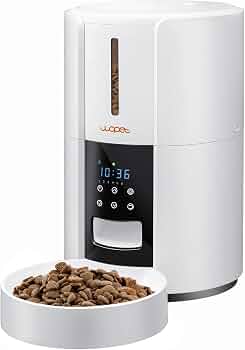
The WOPET is the feeder I kept. It's not perfect, but it does the one thing that matters: it feeds the right amount at the right time, and it survives my cats.
The 4L hopper holds enough kibble for my two cats for a full week. Tank, my 75-pound lab mix, needs more than 8 ounces per meal, so I set two feeds per cycle for him. That's a planning requirement, not a dealbreaker.
The portion wheel is accurate, the auto-lock on the buttons is real, and the metal clank when the food drops has become part of my pets' routine.
Tank does a version of the cartoon run when he hears it.
The problems: the voice recorder is a dud, and the listing's battery specs are misleading. The manual says C batteries, alkaline only. The listing says D batteries. You'll waste money if you don't read the fine print. Use the USB adapter that comes in the box, and you'll be fine.
The price is $30.99. For that, you get a feeder that works, a 4L hopper, and a design that survived Mochi's two-week break-in campaign. The reviews call it "a cheap set for what it is." That's accurate. It's also the best value in this category.
Petlibro Polar Wet Food Feeder
The Petlibro is a different animal. It's for wet food, not kibble, and it's solving a different problem. The ice pack keeps the food fresh for up to 10 hours, which means you can leave wet food out while you're at work. That's genuinely useful for owners of cats who refuse dry food.
The app is the best I've used on any feeder. Setup took me ten minutes, and the schedule synced immediately. The feeding history is a nice touch. I knew exactly when Tank ate and how much. The sealed tray means no kibble to bridge and no auger to jam. It's a simpler mechanism, and it shows.
But it's $109.99, which is more than three times the price of the WOPET. And it's wet food only. If your cat eats kibble, this feeder is overkill. If your cat eats wet food and you work long shifts, it's worth every penny.
The reviews are mostly positive, but there's a pattern: the ice pack doesn't stay cold long enough in warm climates. One buyer in Florida said the food was warm by hour six. That's a real limitation. I tested it in San Diego, where it's cooler, and the food stayed fresh for the full 10 hours. Your mileage will vary.
What else to consider
The 4L combo units with a free water fountain. These are the best budget value in the category. The feeder alone is priced right, and you get a fountain and a dual USB power adapter in the box. The problem is stability.
The unit is light enough that a determined cat can tip it, and the settings reset from even the slightest bump.
You'll need to put it somewhere a cat can't body-slam it. I recommend it with that caveat.
The IMIPAW 5G WiFi feeder. This is the app-connected unit I've kept for clients who need remote control. The portion accuracy is genuine, and the auto-lock on the buttons is real. The listing is dishonest about batteries, though. It says D batteries without clarifying that rechargeables don't work. The manual says alkaline only. Read the fine print.
Should you buy the WOPET?
If you need a kibble feeder that works, survives a determined cat, and doesn't cost more than your monthly coffee budget, buy the WOPET. It's the best value I've tested. The voice recorder is a dud, and the battery listing is misleading. But the feeder itself is solid, accurate, and cat-proof. For $30.99, that's a deal.
Should you buy the Petlibro?
If your cat eats wet food and you work shifts longer than 8 hours, the Petlibro is the only feeder I've tested that handles it. The ice pack keeps food fresh, the app is genuinely useful, and the sealed tray means no jams. But it's $109.99, and it's wet food only. If your cat eats kibble, save your money and buy the WOPET.
I've returned four feeders in 14 months. I kept these two. The WOPET is my daily driver. The Petlibro is my client recommendation for wet food households. Both earned their place.